

As the UK moves closer to the full implementation of the Employment Rights Act, businesses relying on flexible shift patterns must re-evaluate their staffing strategies.
For operations, HR, and procurement managers in sectors like logistics, hospitality, and retail, navigating these changes requires moving away from reactive scheduling toward a more structured, long-term workforce model.
Here is an objective overview of what is changing, the limitations of traditional workarounds, and how a hybrid workforce model can help your business maintain operational agility.
What’s happening to zero-hour / casual contracts?
The new legislation introduces specific regulatory requirements for businesses utilizing zero-hour or low-hour contracts. Managing these requirements will require a more structured approach to workforce planning.
- The Right to Guaranteed Hours: Under the new rules, if a worker consistently works shifts over a defined reference period (typically 12 weeks), the employer is required to offer them a contract guaranteeing a baseline of hours that reflects that historical average.
- Reasonable Shift Notice: Employers will be required to provide reasonable advance notice of shift allocations, making last-minute or highly volatile rotas harder to sustain operationally.
- Compensation for Short-Notice Cancellations: If a shift is cancelled, shortened, or moved within a short timeframe, employers will be required to compensate the worker for the lost hours. This introduces a direct financial cost to managing sudden drops in demand.
These measures mean a higher administrative and financial burden for businesses with fluctuating, seasonal, or unpredictable demand.
Why Traditional Agency Models Don't Solve the Challenge
A common initial thought for businesses facing these regulations is to outsource their flexible staffing needs entirely to traditional temporary recruitment agencies. However, the legislation has been drafted with clear guardrails to prevent this.
The Act explicitly extends guaranteed-hours rights to agency workers, and crucially, the obligation to offer the contract falls primarily on the hirer (the end client), not the agency.
Furthermore, the framework includes robust anti-avoidance provisions. If a business intentionally rotates temporary workers or curtails assignments simply to prevent them from hitting the 12-week threshold, it risks substantial compliance penalties at an employment tribunal. Relying on traditional agencies to bypass the rules is not a viable long-term strategy.
Building a Compliant, Resilient Model with Temper
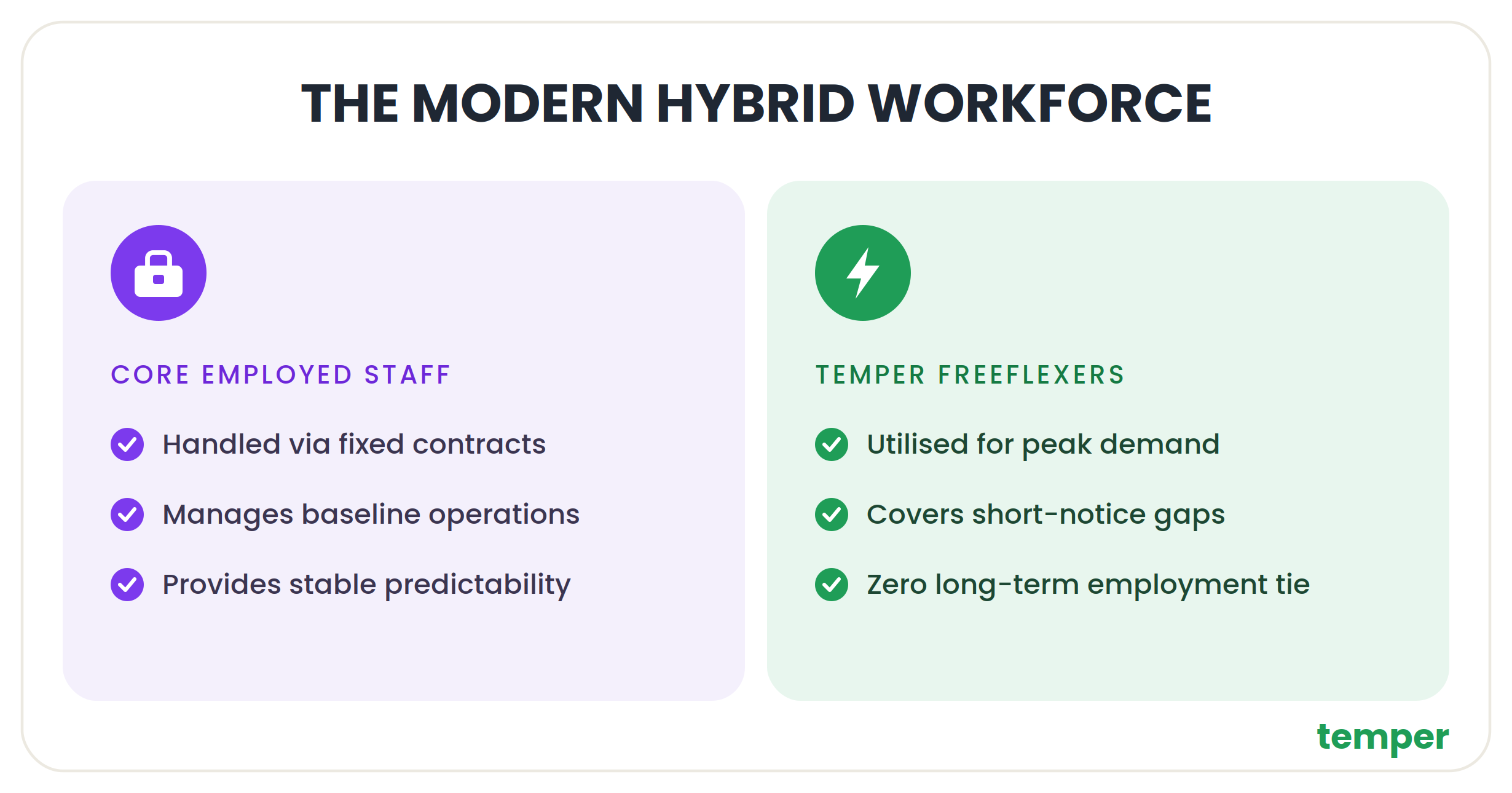
To stay agile without increasing fixed employment costs or administrative overhead, forward-thinking businesses are adopting a hybrid workforce model. This involves clearly separating your core operational staff from your true ad-hoc, flexible resource.
This is where a platform like Temper becomes a powerful strategic asset.
Temper is a digital marketplace that connects businesses directly with independent, self-employed professionals (FreeFlexers). Because FreeFlexers use the platform as autonomous contractors—choosing their own rates, selecting their own shifts, and maintaining full control over when and where they work—they operate entirely outside the scope of zero-hour employment regulations.
By integrating Temper into your workforce strategy, your business can confidently manage fluctuating demand while remaining fully compliant:
- Secure Your Core: Focus your internal employment efforts on a dedicated, permanent team to manage your predictable, baseline daily operations.
- Scale Dynamically for Peaks: When seasonal surges occur, or unexpected client demands arise, you can supplement your core team by posting one-off shifts on Temper. You scale your headcount up or down in real-time with zero risk of triggering a 12-week guaranteed hours obligation.
- Create Reliable 'Flexpools': When you find independent professionals on Temper who understand your business and deliver great results, you can add them to your digital "Flexpool." This allows you to invite them back for future ad-hoc shifts with a single click, ensuring quality and continuity.
Ready to build your flexible layer via Temper? Sign up now → and post your first shift. No contracts, no setup fees, no commitment.
The regulatory environment is changing, but the need for business agility remains the same. By shifting from variable employment contracts to a true B2B freelance model for your flexible labour, you can future-proof your operations via Temper.
Have questions first? Get in touch with Alex Rose at alex.rose@temper.works to discuss your operational needs.